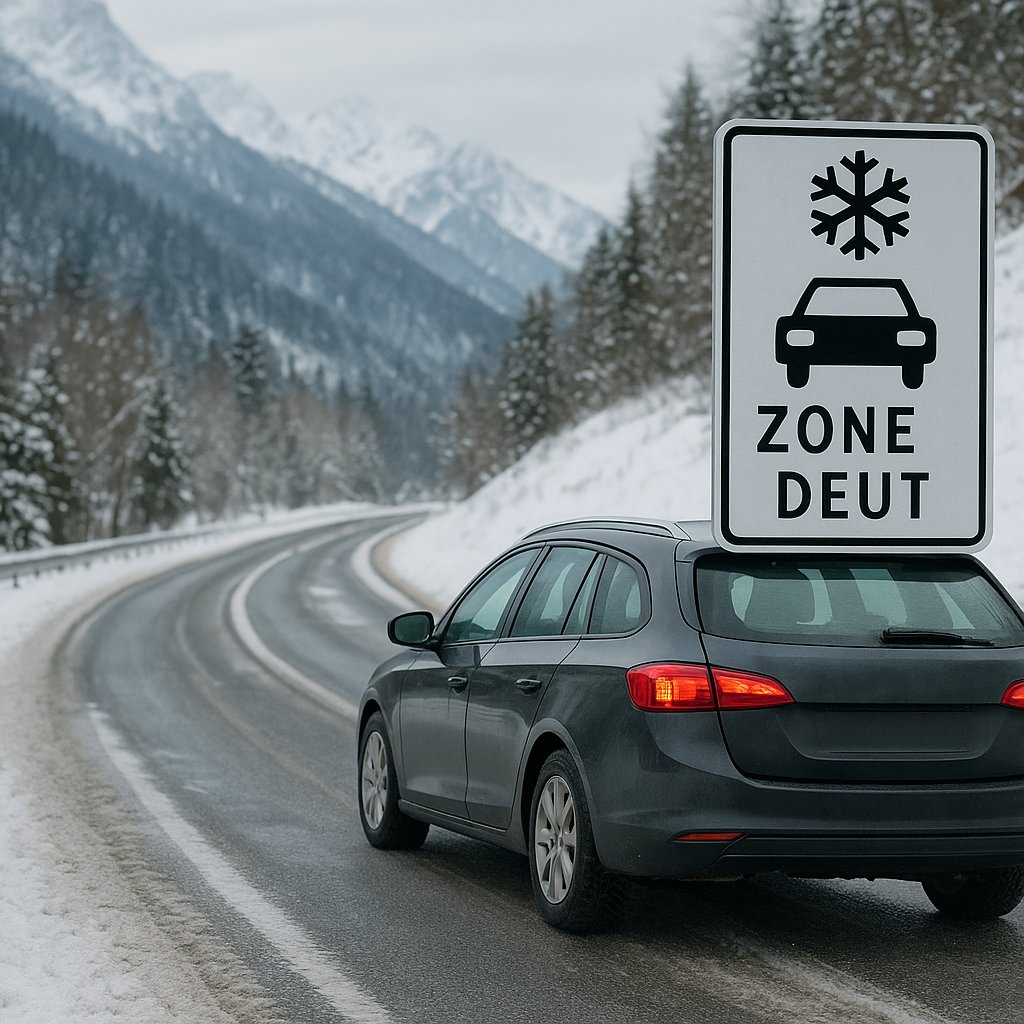
SEO title: Loi Montagne 2025-2026: winter tyres or snow chains? Meta description: Driving to France? Check Loi Montagne 2025-2026: 3PMSF vs M+S, B58/B59 signs, snow chains, the €135 fine, and a quick checklist. URL slug: loi-montagne-2025-2026-winter-tyres-snow-chains-france
Loi Montagne 2025-2026: are winter tyres or snow chains mandatory in France?
You’re (almost) heading to the French Alps, the Pyrenees or another mountain area. And then comes the classic question: “Can I drive there on my tyres, or do I need to carry chains?”
France’s Loi Montagne exists for one main reason: to stop people with “almost-okay” tyres from blocking a mountain pass the moment it starts snowing.
In a few minutes, this article will tell you:
- whether you’re allowed to drive (in the right zones and period),
- what you need at a minimum (3PMSF or chains),
- and how to avoid fines and hassle.
TL;DR (quick answer)
- Season 2025-2026: in the designated mountain zones, the winter equipment requirement applies from 1 November 2025 to 31 March 2026.
- 3PMSF vs M+S in one sentence: M+S on its own isn’t enough; you need tyres with the 3PMSF symbol (mountain with a snowflake) or you must be able to fit snow chains/traction devices when required.
- Not sure? Check your tyre sidewall for the mountain + snowflake and bring chains that fit (and practise fitting them once at home).
Loi Montagne 2025-2026 in 60 seconds (what is it and when does it apply?)
What is “Loi Montagne” (and what does it mean for Dutch drivers)?
The Loi Montagne is France’s winter rule for certain mountain areas. In those zones, during the winter period, your vehicle must have appropriate winter equipment.
In practice, as a Dutch driver, that means:
- You enter a mountain zone (often on routes to ski resorts).
- You must either have 3PMSF-rated tyres, or carry chains/traction devices that you can fit.
- During checks or winter conditions, otherwise you may be stopped or turned back.
Key point: this isn’t a “whole of France” rule—it’s a zone-based rule.
Dates for the 2025-2026 season (exact)
For the 2025-2026 season, the winter equipment requirement in the designated zones applies from:
- 1 November 2025 to 31 March 2026
This period returns every year during the winter months. Heading to the mountains in December, January, February or March? Then you’re right in the middle of it.
Does it apply even if it’s dry and there’s no snow?
Yes. In practice, it’s based on period + zone + signage. So it applies even if it’s dry down in the valley.
That can feel excessive—until you drive 20 km further and hit a shaded stretch, a mountain pass or a higher valley where it is slippery. France wants to prevent traffic from grinding to a halt.
Typical regions where you’ll often encounter it
Loi Montagne zones are mainly found in (parts of):
- The Alps
- The Pyrenees
- The Jura
- The Vosges
- The Massif Central
Note: it’s about designated municipalities. Not every road in every mountain department automatically falls under the same requirement. But if you’re driving towards a ski resort, there’s a good chance you’ll see the relevant signs.
3PMSF vs M+S (this is where it often goes wrong)
How to spot 3PMSF in 10 seconds
3PMSF stands for Three Peak Mountain Snow Flake.
On your tyre you’ll see a pictogram of a mountain with a snowflake.
- Do you see a mountain + snowflake? That’s the marking France accepts (in this context) as a clear winter-tyre indicator.
- Do you only see M+S (Mud + Snow) but no mountain + snowflake? Then you’re often not automatically “good to go”.
Tip: use your phone torch and check more than one tyre (the marking can sometimes be on only one side of the tyre).
Why M+S alone is no longer the safe answer
M+S is not a performance certification like 3PMSF. It doesn’t say the same thing about tested winter performance.
That’s why “it says M+S” is no longer the reassurance many Dutch drivers think it is.
Practical consequences:
- With only M+S, in a Loi Montagne area you may need chains.
- And during a check, it can lead to discussion if you don’t have 3PMSF and you also can’t show chains that fit.
What about all-season tyres?
All-season can be fine—as long as the tyre has 3PMSF.
- All-season with 3PMSF: usually sufficient for the winter equipment requirement in the zones.
- All-season without 3PMSF (only M+S or nothing): bring chains and don’t assume you automatically comply.
Examples (plain language)
- Example 1: Your tyre has “M+S”, no mountain + snowflake → bring chains if you’re heading into mountain zones. There’s a good chance you’ll genuinely need them at some point.
- Example 2: You have all-season tyres with 3PMSF → you’re generally fine, but in heavy snow/steep roads there can still be local chain requirements.
- Example 3 (rental car): “Winter tyres included” on paper is nice, but what matters at the roadside is what’s on the tyre. Check for 3PMSF with the rental company before you leave.
Quick check now (30 seconds): Go outside and look on the tyre sidewall for 3PMSF. Take a photo if needed. It saves doubt (and discussions) on the road.
Decision tree: can I drive into the mountains on my tyres? (copy/paste)
Use this as a quick decision tree—handy if you’re leaving tomorrow.
- Am I driving between 1 Nov and 31 Mar towards a mountain area/ski resort?
- No → Loi Montagne is probably not relevant (but stay alert for local winter conditions).
- Yes → continue.
- Do my tyres have 3PMSF?
- Yes → you generally comply with the winter equipment requirement.
- No / not sure → continue.
- Do I have snow chains/traction devices with me that fit and that I can fit?
- Yes → you can comply, but make sure you can actually use them.
- No → sort it before departure (otherwise this is your biggest risk of being turned back/fined).
- Do I see B58/B59 signs or a chain-required situation?
- Saw B58 → you’re in/at the start of a zone: check 3PMSF/chains.
- Local chain requirement (snow/checkpoint) → fit them when instructed.
- Saw B59 → end of the zone.
B58 and B59 signs: what they mean (and what you do)
In France, the winter equipment zone is shown in practice with road signs.
- B58 = start of a zone/section where winter equipment is mandatory.
- B59 = end of the requirement/zone.
What you should do at B58:
- Quickly check: do I have 3PMSF or are my chains within easy reach?
- Is the road turning white or do you see a checkpoint? Fit chains early at a safe spot (lay-by/chain fitting area).
Snow chains in France: how many do you need and on which wheels?
How many chains should you bring?
For most passenger cars, this is the practical baseline:
- 2 snow chains (for the driven wheels).
In some situations (steep mountain roads, heavy snowfall, specific local instructions) you may need more, but for most ski trips “2 chains for the drive axle” is the standard.
Front-wheel drive, rear-wheel drive or 4x4: where do they go?
- Front-wheel drive: chains on the front wheels.
- Rear-wheel drive: chains on the rear wheels.
- 4x4/AWD: follow your owner’s manual. Sometimes fitting on one axle is allowed/recommended. 4x4 helps you pull away, but it’s not magic for braking/steering on ice.
Practising avoids stress (really—do this once)
Do a short “dry run” at home:
- Do the chains fit your tyre size?
- Do you understand the fastening mechanism?
- Can you do it within 5 minutes?
Bring:
- gloves
- a kneeling mat or an old cloth
- a torch (it gets dark early in the mountains)
Fine & enforcement: what’s the real risk?
Fine and possible consequences
If you drive in a zone without the correct winter equipment, you risk a fine of €135.
In addition, the police/gendarmerie may in practice:
- make you turn around, or
- immobilise your car until you fix the issue.
Often, the biggest pain isn’t the €135, but the lost time: accommodation, chain fitting areas, traffic jams—your trip can unravel quickly.
When are you most at risk?
The chance of checks/hassle is higher:
- during snowfall and icy conditions
- on access routes to ski resorts and mountain passes
- on busy changeover days and holiday peaks
Season hook for 2026 (busy weeks): French winter school holidays start by zone from 7 February 2026. The Dutch spring break often starts from 14 or 21 February 2026 (depending on region). Those weeks are busy, and the chance of checks and bottlenecks is higher.
Checklist (copy/paste): stress-free driving to the Alps
24 hours before departure
- Check tyre marking: is 3PMSF (mountain + snowflake) on the sidewall?
- Check tyre condition: enough tread, no damage
- Need chains? Test-fit them on one wheel (dry practice)
- Pack: gloves, kneeling mat/old cloth, torch
In the car (useful—and often mandatory—items)
- Snow chains (matching your tyre size) + instructions
- Reflective vest (within reach)
- Warning triangle
- Phone charger/power bank
- Ice scraper + winter screenwash
On the road (quick checks)
- Watch for B58/B59 signs
- Check weather/road status in mountain areas (it can differ per valley)
- Fit chains in a safe place (chain fitting area/parking), not only once you’re already slipping
Pin this: copy this checklist into your notes and tick it off in the car park.
FAQ (short, no fuss)
Are winter tyres mandatory everywhere in France?
No. It applies in designated mountain zones during 1 Nov to 31 Mar, and is indicated locally with signs.
I have M+S tyres. Am I covered?
Not automatically. M+S is not the same as 3PMSF. Without 3PMSF you should seriously plan on chains (and checks).
I have all-season tyres. What should I look for?
Look for 3PMSF on the tyre. All-season with 3PMSF is generally fine; without 3PMSF: bring chains.
Do I need to carry chains if I have 3PMSF?
With 3PMSF you usually comply with the equipment requirement. But in severe conditions you can still run into situations where chains are practically needed (or locally required). If you’re truly heading into the mountains, carrying chains is often still sensible.
What do the B58 and B59 signs mean?
- B58: start of winter equipment zone.
- B59: end of the zone.
Does it apply even if it’s not snowing?
Yes, it mainly depends on zone + period + signs. It can be dry lower down and treacherous higher up.
What’s the fine, and can you be stopped?
Expect €135 and the risk that you can’t continue (turning back or immobilisation) until you resolve it.
Summary (what to remember before you leave)
- In mountain zones, season 2025-2026 runs 1 November 2025 to 31 March 2026 for winter equipment.
- 3PMSF (mountain + snowflake) is the clear check; M+S alone is not a safe “yes”.
- No 3PMSF? Bring snow chains that fit and practise fitting them once.
Want more practical, seasonal checklists like this? See more practical checklists on the blog. For businesses looking to capture this kind of seasonal-peak traffic: see all services for more organic traffic or let me build your seasonal-peak content strategy.